Your indoor air could be up to five times more polluted than outdoor air, silently impacting your health while you sleep, work, or relax. If you’re struggling with allergies, wildfire smoke, or persistent household odors, the right air purifier transforms your living space—but most buyers waste money on units that underperform because they don’t understand their specific requirements. This guide cuts through confusing marketing claims to help you select an air purifier that actually solves your air quality problems.
You’ll discover how to calculate your exact room requirements, identify which technologies genuinely work for your specific pollutants, and avoid costly mistakes that trap 80% of first-time buyers. By the end, you’ll have a clear roadmap to choose an air purifier that delivers clean air without breaking the bank on hidden filter costs.
Calculate Your Exact Room Requirements Before Buying

Choosing an air purifier that’s too small creates frustration as it struggles to clean your space, while oversized units waste energy and create unnecessary noise. The key metric you need is Clean Air Delivery Rate (CADR), which measures how quickly a unit cleans the air in cubic feet per minute.
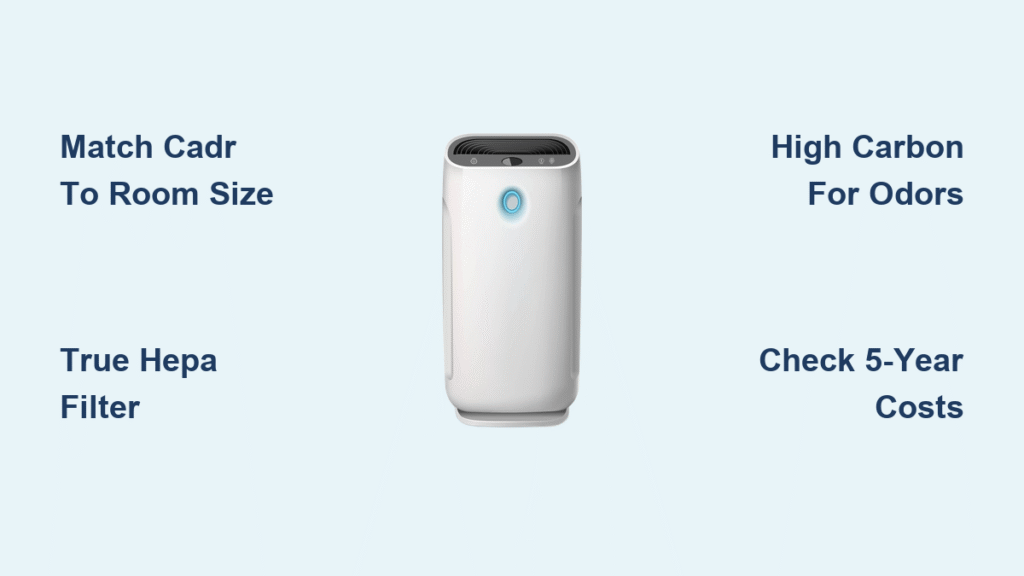
Match CADR to your room size using this simple rule: Your purifier’s CADR should equal at least two-thirds of your room’s square footage. For a 300 square foot bedroom, you need a minimum CADR of 195 cfm. Check the AHAM Verifide® label for certified CADR numbers—never trust manufacturer claims without verification.
Verify Air Changes Per Hour for Effective Cleaning
A single pass through the filter isn’t enough—air must cycle multiple times for real improvement. Aim for 4-5 air changes per hour for noticeable results. Calculate this by multiplying CADR by 60, then dividing by your room’s volume (length × width × height). A 300 sq ft room with 8-foot ceilings needs that 195 cfm unit to achieve 4.9 air changes hourly. If your math shows fewer than 4 changes, step up to a higher CADR model.
Target Your Specific Air Quality Problems

Most air purifiers excel at solving one type of problem but fail at others. Being specific about your primary pollutants prevents wasted money on ineffective technology.
Allergens vs. Smoke vs. Chemical Odors: Different Solutions
- For dust, pollen, and pet dander: You need True HEPA filtration that removes 99.97% of particles 0.3 microns or larger
- For wildfire smoke or tobacco: Prioritize high smoke CADR ratings and substantial carbon filtration
- For cooking odors or VOCs: Look for 5+ pounds of activated carbon—most budget units contain less than 2 ounces
Pro tip: If you’re fighting both particles AND gases (like wildfire smoke), budget for separate solutions—most units can’t effectively handle both types of pollutants. Pair a HEPA purifier with a dedicated carbon unit for comprehensive protection.
Filter Technology That Actually Works (Avoid These Traps)

Understanding filtration technology prevents expensive mistakes that render your purifier nearly useless.
True HEPA vs. Marketing Hype
Only “True HEPA” or “H13 HEPA” meets the 99.97% efficiency standard. Manufacturers often use misleading terms like “HEPA-type,” “HEPA-like,” or “99% HEPA” for filters that capture far fewer particles. Always verify the exact specification—this single factor determines whether your unit actually removes allergens.
Carbon Filter Reality Check
Most air purifiers include token carbon filters with less than 1 pound of material, barely effective for odors. For serious VOC or smoke gas removal, seek units like Austin Air HealthMate (15 pounds carbon/zeolite) or IQAir models with multi-pound carbon stages. Budget models often skip meaningful carbon filtration entirely—don’t expect them to eliminate cooking smells or formaldehyde.
Dangerous Technologies to Avoid
- Ozone generators: Marketed as “air purifiers” but create harmful ozone that damages lungs
- Ionizers: Often produce ozone as a byproduct and leave particles clinging to surfaces
- PCO (photocatalytic oxidation): Limited real-world effectiveness against VOCs
Performance Metrics That Matter Most
Focus on certified ratings rather than marketing fluff that overpromises results.
Decode CADR Ratings for Your Specific Needs
Look for separate CADR ratings for smoke, dust, and pollen. Smoke CADR is most critical for wildfire areas since it measures removal of the smallest, most dangerous particles (0.1-1 micron). If a manufacturer only claims “99.9% effective” without specific CADR numbers, walk away—this is a major red flag.
Noise and Energy Reality Check
Bedrooms demand under 40 dB (whisper-quiet operation), while living areas can tolerate up to 50 dB (refrigerator hum level). Check noise ratings at medium speed—not just the quietest setting. Energy Star models save 40% on electricity costs—a $200 unit might cost $150/year to operate at high speed, while an Energy Star model could run for $60. Always calculate 5-year operating costs before purchasing.
Maintenance Costs That Surprise Most Buyers

Filter replacement costs often exceed the initial purchase price over time—budget accordingly.
True 5-Year Cost Comparison
- Coway AP-1512HH: $500 total ($200 purchase + $250 filters + $50 electricity)
- Molekule Air Pro: $2,500+ total ($800 purchase + $1,400 filters + $300 electricity)
- Budget model: Often exceeds $1,000 when including filter costs
Critical step: Before buying, verify filter availability from major retailers and check third-party alternatives. Some brands create artificial scarcity to boost profits on proprietary filters. Set calendar reminders for replacements—running a purifier with expired filters wastes energy and provides minimal cleaning.
Your 6-Step Decision Framework
Follow this sequence to choose confidently without getting overwhelmed by options.
- Measure your room and calculate minimum CADR (2/3 of square footage)
- List your primary pollutants (allergens vs. smoke vs. VOCs)
- Set total budget including 5-year filter and electricity costs
- Verify noise levels for your intended location (bedroom = under 40 dB)
- Confirm True HEPA certification—no “HEPA-type” compromises
- Check filter availability and replacement schedule before purchasing
Final Checklist Before Clicking “Buy”
- [ ] CADR ≥ 2/3 room square footage (verified AHAM rating)
- [ ] True HEPA filter confirmed (not marketing terminology)
- [ ] Filter replacements fit your long-term budget
- [ ] Noise ≤50 dB at effective speeds for location
- [ ] Energy Star certified for lower operating costs
- [ ] Filter availability confirmed through multiple retailers
- [ ] Display shutoff feature for bedroom use
- [ ] Minimum 2-year warranty with US-based support
Once you’ve selected your air purifier, run it continuously for maximum effectiveness—air quality improves significantly after 24-48 hours of constant operation. Position it centrally with 18+ inches clearance from walls, and replace filters on schedule (not when visibly dirty). Within days, you’ll breathe noticeably cleaner air in your personal sanctuary, free from the frustration that traps most air purifier buyers. The right unit pays for itself through better sleep, fewer allergy symptoms, and genuine peace of mind knowing your indoor air quality is finally under control.