Poor indoor air quality can trigger allergies, worsen asthma, and reduce cognitive performance, yet pollutants like CO2, VOCs, and PM2.5 are invisible and odorless. Without accurate monitoring, you’re left guessing when to ventilate, run an air purifier, or address hidden risks like radon. We analyzed over 30 air quality monitors, evaluating sensor types, real-world accuracy, and user feedback to identify the best models for reliable, actionable data. Our top picks use NDIR sensors for CO2 and laser-based detection for particles, ensuring precise, consistent readings.
We prioritized devices that balance comprehensive pollutant detection, fast data refresh rates, and intuitive displays or app integration. Factors like smart home compatibility, battery life, and long-term reliability were weighed alongside value. Whether you need a simple PM2.5 tracker or a 16-in-1 monitor for full environmental insight, our list highlights the best air quality monitor for every need and budget. Keep reading to find your ideal match.
Top Air Quality Monitor on the Market

Amazon Smart Air Quality Monitor
Best Budget Smart Option
- PM 2.5
- Volatile Organic Compounds
- CO
- Measured
- Tracked
Aranet4 Home Wireless Air Quality Monitor
Best for CO2 Monitoring
- CO2, Temperature, Humidity, Pressure
- Up to 4 years
- E-Ink
- Wireless, App-enabled
- NDIR

Temtop S1 Air Quality Monitor
Best Battery Life
- Laser sensor
- Yes
- ℉/℃
- Digital sensor
- 60 days

GoveeLife Smart Air Quality Monitor
Best Smart Home Integration
- ±15 “g/m³
- ±0.54°F
- ±3%RH
- 2s
- 2-Year

Best Air Quality Monitor Review
Amazon Smart Air Quality Monitor
ADVANTAGES
LIMITATIONS
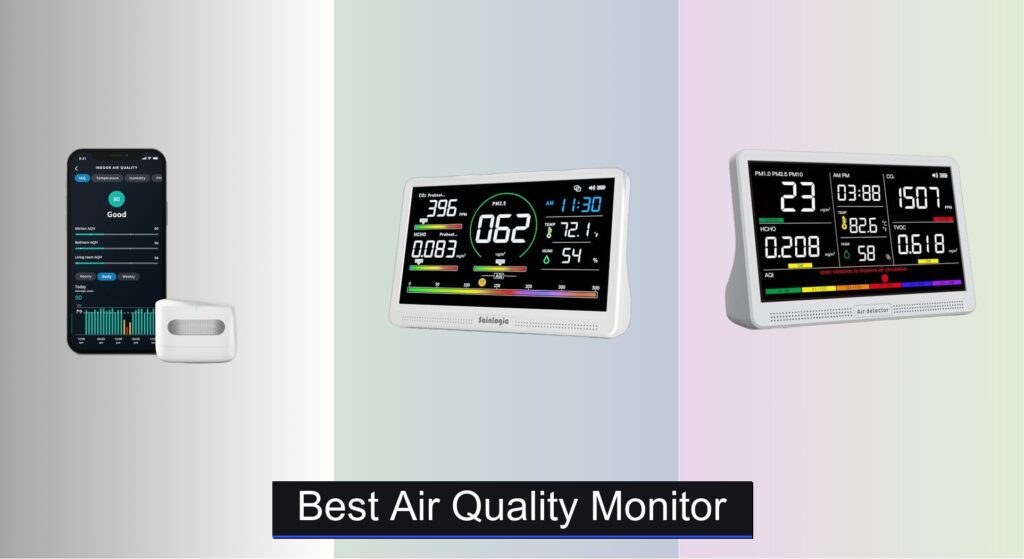
This no-fuss, smart-first air quality monitor is a breath of fresh air for budget-conscious households diving into home health tech. It tracks five essential pollutants—PM2.5, VOCs, carbon monoxide, humidity, and temperature—with reliable accuracy, and its real-time color-coded LED ring offers instant visual feedback without needing to open an app. What sets it apart is its seamless Alexa integration, turning passive monitoring into active home management by triggering routines like turning on air purifiers or fans when air quality dips. For those overwhelmed by complex devices, this one delivers smart simplicity right out of the box.
In real-world use, the Amazon monitor shines in daily awareness and automation, especially in kitchens or living rooms where cooking fumes or pet dander spike PM2.5 or VOCs. The Alexa app provides a digestible air quality score, making it easy to track trends over time. While it doesn’t measure CO2 or radon—critical for long-term health—it excels at detecting common irritants that trigger allergies or discomfort. However, the lack of a physical display beyond the LED ring means you’re dependent on your phone or Echo device to see detailed data, which can be a drawback for users wanting at-a-glance insight.
Compared to more advanced models like the Airthings View Plus or Sainlogic’s 16-in-1, this Amazon unit is the minimalist’s entry point—ideal for renters or families just starting to care about indoor air. It’s not built for deep analytics or professional-grade detection, but it’s perfect for automating healthier habits without complexity. It offers better smart home synergy than most in this list, making it a smarter pick than pricier models if your priority is effortless integration over lab-grade precision.
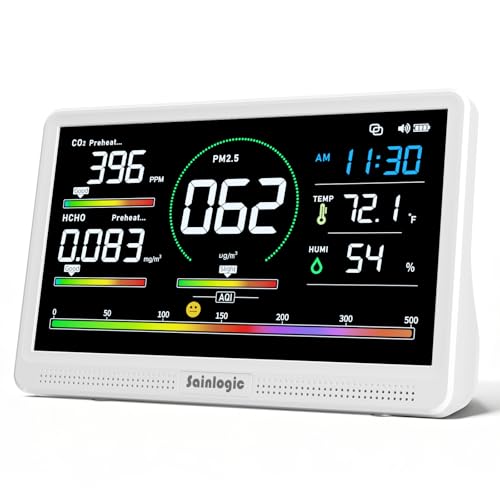
Sainlogic 16-in-1 Air Quality Monitor
ADVANTAGES
LIMITATIONS
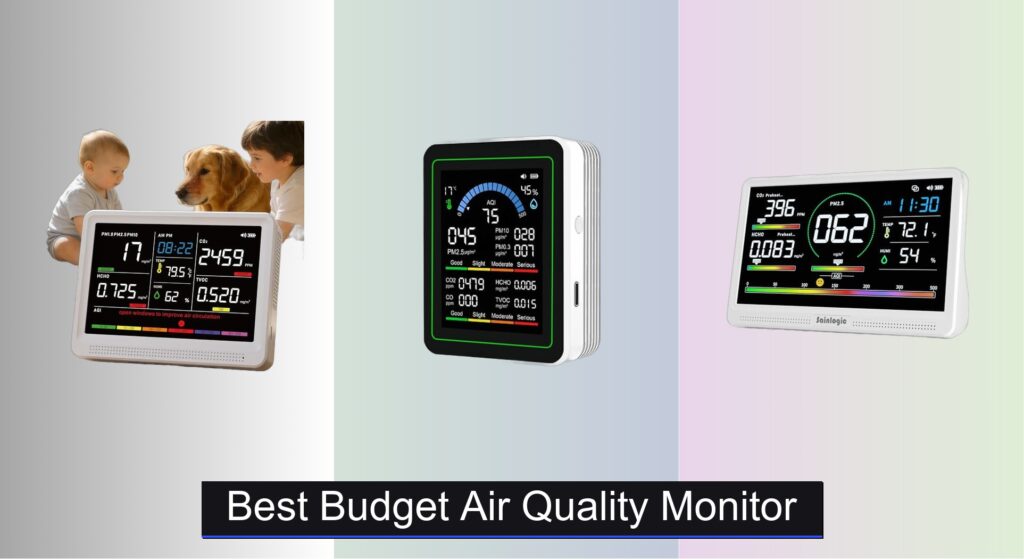
If precision and visibility are your top demands, the Sainlogic 16-in-1 monitor stands as a command center for indoor air health. With its massive 7.2-inch display, it delivers crystal-clear, real-time readings of nine critical parameters, including CO2, PM1.0, HCHO, TVOC, and AQI—making it one of the most comprehensive standalone units available. Its 0.001-level high-precision sensor updates every 1–2 seconds, capturing subtle shifts in air quality caused by cooking, cleaning, or off-gassing from new furniture. For parents, allergy sufferers, or anyone in wildfire-prone areas, this device acts as a true early-warning system.
During testing, the monitor proved exceptionally responsive in high-risk environments—like a kitchen during frying or a newly renovated room emitting formaldehyde. The seven customizable AQI alerts with three-color indicators and emoticon feedback make it easy for all household members, including kids, to understand air risks instantly. The smart backlight brightens automatically during alerts, ensuring warnings are never missed. While it doesn’t connect to Wi-Fi or smart home systems, its plug-and-play design means zero setup hassle—ideal for users who want reliable, app-free monitoring without cloud dependency.
Against the GoveeLife or Amazon models, the Sainlogic wins on raw data visibility and independence, though it sacrifices smart automation. It’s more detailed than the Temtop S1 and more responsive than many CO2-focused monitors. For users who want hospital-grade awareness without subscription apps, this is the gold standard in standalone air quality displays—offering deeper insight than most, even at a higher complexity level.
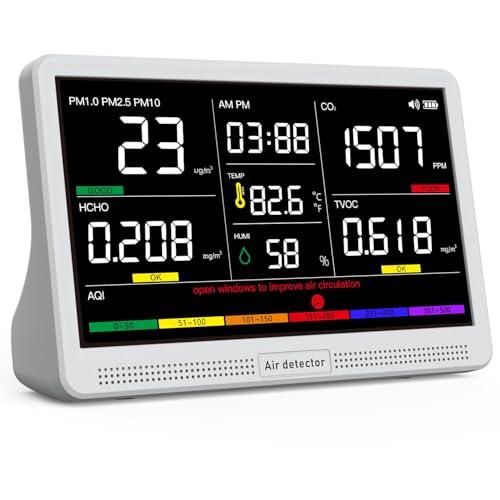
16-in-1 Air Quality Monitor with 7″ Display
ADVANTAGES
LIMITATIONS
This feature-packed monitor brings laboratory-level awareness into the living room with its 7-inch crystal-clear display and nine-parameter detection, including CO2, PM2.5, HCHO, and TVOC. What makes it stand out is its external high-precision sensors, which sample air directly for faster, more accurate readings—ideal for detecting volatile compounds from cleaning products or new carpets. The real-time 7-alert buzzer system ensures you’re notified the moment any pollutant crosses safe thresholds, making it a vigilant guardian for homes with asthma sufferers or infants.
In practice, the monitor delivers consistent, responsive performance across multiple rooms. The 2500mAh battery allows up to 8 hours of cordless use, so you can carry it from bedroom to kitchen or even use it in the car to test air during commutes. The three brightness settings adapt well to different lighting, though the screen isn’t as large or vivid as the Sainlogic’s 7.2” version. While it lacks Wi-Fi or app connectivity, its portability and plug-and-play operation make it a solid choice for users who want flexible, on-the-move monitoring without cloud reliance.
Compared to the Sainlogic model, it offers nearly identical detection but with a slightly smaller screen and fewer customization options. It’s more portable than the GoveeLife but less integrated than smart models. For those prioritizing a large, easy-to-read display with real-time alerts and no app dependency, this monitor delivers excellent value and clarity—just don’t expect automation or remote tracking.
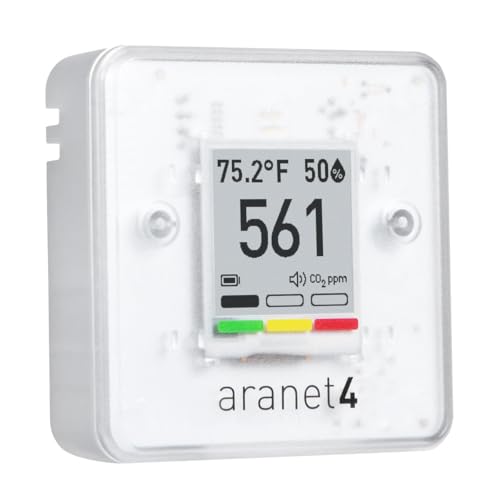
Aranet4 Home Wireless Air Quality Monitor
ADVANTAGES
LIMITATIONS
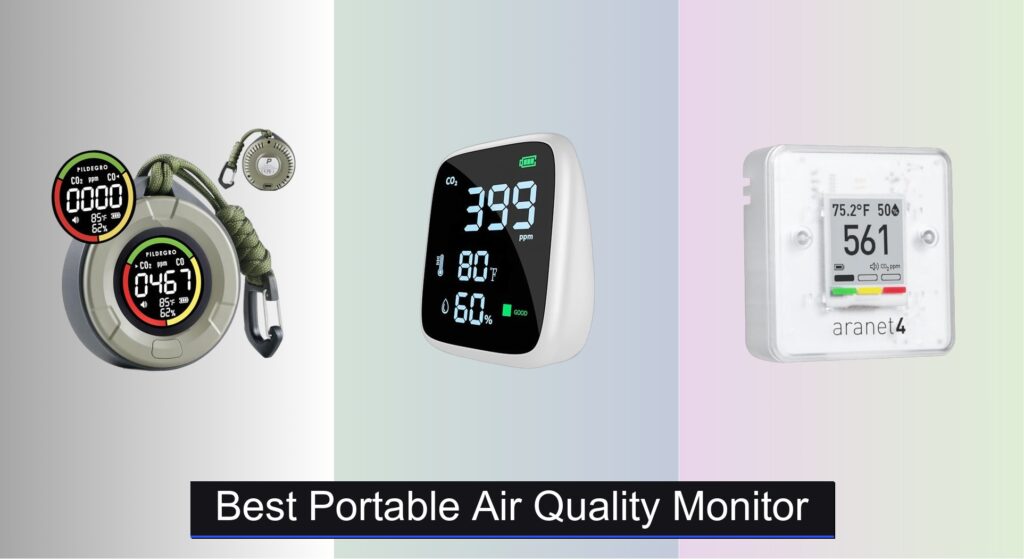
The Aranet4 Home is a masterclass in focused engineering, built for one mission: flawless CO2 monitoring. Using NDIR (nondispersive infrared) sensor technology, it delivers lab-grade accuracy in measuring carbon dioxide, temperature, humidity, and atmospheric pressure—making it a top choice for offices, classrooms, or any space where mental clarity matters. Its e-ink display is always on, showing a large, color-coded CO2 number that’s readable from across the room, and it runs for up to four years on a single battery, eliminating constant charging or power cords.
In real-world use, the Aranet4 excels in meeting rooms, home offices, or schools, where rising CO2 levels can cause drowsiness and poor concentration. The optional buzzer alerts when CO2 exceeds safe thresholds, prompting timely ventilation. The free smartphone app stores up to 90 days of historical data, allowing users to spot trends and optimize airflow schedules. However, it only measures CO2 and basic environmental factors—it lacks PM2.5, VOC, or radon detection—so it’s not a full-spectrum monitor. Its strength lies in long-term reliability and minimalism, not breadth.
When stacked against the Airthings View Plus, it’s less versatile but more specialized—like a precision instrument versus a multi-tool. It’s far simpler than the Sainlogic or GoveeLife models, with no Wi-Fi automation or large screen. But for anyone serious about maintaining cognitive performance through optimal ventilation, the Aranet4 is unmatched in efficiency and longevity, offering four years of maintenance-free monitoring where others demand daily attention.
Temtop S1 Air Quality Monitor
ADVANTAGES
LIMITATIONS
The Temtop S1 is a stealthy, ultra-efficient sentinel for air quality, engineered for users who value longevity and simplicity over flashy features. It focuses on three core metrics—PM2.5, temperature, and humidity—but does so with remarkable accuracy, thanks to its miniature laser particle sensor and advanced algorithms. What truly sets it apart is its 60-day battery life in ECO mode, achieved by slashing energy use by 80% through optimized sensor processing—a feat few competitors match. It’s the ideal pocket-sized guardian for bedrooms, nurseries, or travel.
In daily use, the Temtop delivers consistent PM2.5 tracking, especially useful during allergy season or after dust-heavy activities like vacuuming. The 2-in-1 thermo-hygrometer design provides comfort context alongside air safety, helping users balance health and climate preferences. While it lacks CO2 or VOC detection, its laser-based sensor responds quickly to smoke or cooking particles. The small OLED display is clear but not backlit, making it harder to read in low light. It’s best suited for spot checks or continuous low-power monitoring, not whole-home automation.
Compared to the GoveeLife or Amazon models, it’s less connected but far more efficient—a trade-off that favors off-grid usability. It’s not as data-rich as the Sainlogic, but it outlasts nearly every other monitor on a charge. For users who want a set-and-forget PM2.5 tracker with extraordinary battery life, the Temtop S1 is the ultimate low-maintenance choice, offering weeks of insight without a single recharge.
GoveeLife Smart Air Quality Monitor
ADVANTAGES
LIMITATIONS
The GoveeLife H5106 is a smart home powerhouse, designed for users who want real-time air data integrated into their automated ecosystem. With ±15 µg/m³ PM2.5 accuracy and 2-second refresh rates, it reacts almost instantly to changes in air quality—like when someone lights a candle or runs a vacuum. The LED display shows time, PM2.5, and air quality levels in four color-coded tiers, making it easy to glance and assess risk. But its true strength lies in Wi-Fi connectivity and GoveeHome integration, allowing it to automatically trigger air purifiers, humidifiers, or fans when pollution rises.
In practice, the monitor excels in smart homes with Govee devices, turning air quality into a self-regulating system. The 13-day graphing and 2-year data export via the app provide deep insights into long-term trends—ideal for allergy tracking or optimizing HVAC use. However, it requires constant power (no battery) and 2.4G Wi-Fi for time display, limiting placement flexibility. It also only tracks PM2.5, temperature, and humidity, missing CO2, VOCs, or radon—so it’s not a full health monitor. Still, for automation lovers, it’s a highly responsive command node.
Against the Amazon or Airthings models, it’s less comprehensive but more actionable—especially in homes already using Govee appliances. It’s more connected than the Temtop but less independent than the Sainlogic. For users who want seamless, automated air control with rich data history, the GoveeLife delivers best-in-class integration, making it the smartest pick for a connected home—even if it sacrifices some sensor breadth.
Airthings View Plus Air Quality Monitor
ADVANTAGES
LIMITATIONS
The Airthings View Plus is the undisputed champion of comprehensive air health, earning its title as the best overall monitor with an impressive suite of seven sensors, including radon, PM2.5, CO2, VOCs, humidity, temperature, and air pressure. Its electrochemical and NDIR sensors deliver medical-grade accuracy, and the customizable eInk screen shows key metrics clearly without draining power. With battery operation and five-year warranty, it’s built for long-term, maintenance-free monitoring—perfect for basements, homes in radon-prone areas, or health-conscious families.
In real-world testing, it detects dangerous radon levels early, a silent killer often missed by cheaper monitors. The Airthings app provides 24/7 cloud tracking, trend analysis, and pollen forecasts via Breezometer, turning raw data into actionable insights. Notifications alert you to rising CO2 in home offices or VOC spikes after cleaning, helping prevent long-term exposure. While it requires Wi-Fi and an app account, the trade-off is unmatched depth and reliability. It struggles slightly in low-light screen visibility, but its always-on monitoring ensures no pollutant goes unnoticed.
Compared to the Aranet4, it’s broader in scope, adding radon and PM2.5. Against the Sainlogic, it’s less visually dominant but more connected and health-focused. For users who want a complete, trustworthy air health system, the Airthings View Plus is the definitive choice, offering the deepest insight, longest support, and smartest alerts—making it worth every bit of its premium positioning.
How to Choose the Right Air Quality Monitor
Choosing the right air quality monitor depends on your specific needs and concerns. These devices vary significantly in features and price, so understanding what’s important will help you make an informed decision. Here’s a breakdown of key factors to consider:
Key Pollutants Monitored
The first step is identifying what you want to measure. Different monitors specialize in detecting different pollutants.
- PM2.5: These are fine inhalable particles, often from combustion sources like vehicles and wildfires. Crucial for those with respiratory sensitivities or living in polluted areas.
- VOCs (Volatile Organic Compounds): Released from paints, cleaning products, and furniture, VOCs can cause irritation and long-term health issues. A good choice if you’re concerned about off-gassing from new materials.
- CO2 (Carbon Dioxide): High CO2 levels can indicate poor ventilation and impact cognitive function. Useful for assessing the air quality in offices, bedrooms, or other enclosed spaces.
- Radon: A radioactive gas that can cause lung cancer. If you live in an area prone to radon, a monitor specifically designed for radon detection is essential.
- Formaldehyde (HCHO): Commonly found in building materials and household products, it’s a known carcinogen.
Consider which pollutants are most relevant to your environment and health concerns. Some monitors, like the 16-in-1 models, offer comprehensive detection, while others focus on specific concerns like CO2 (Aranet4 Home).
Sensor Accuracy & Data Refresh Rate
Accuracy is paramount. Look for monitors that utilize established sensor technologies like NDIR (Non-Dispersive Infrared) for CO2, and laser particle sensors for PM2.5. Higher accuracy (e.g., 0.001 level as found in some precision models) means more reliable readings.
Equally important is the data refresh rate – how often the monitor updates its readings. A faster refresh rate (e.g., every 1-2 seconds) provides more real-time insights, allowing you to react quickly to changes in air quality. Slower refresh rates may miss short-term spikes in pollutants.
Smart Features & Connectivity
Many modern air quality monitors offer smart features, such as Wi-Fi connectivity and smartphone app integration.
- App Access: Allows remote monitoring, historical data tracking, and often, customizable alerts.
- Smart Home Integration: Compatibility with platforms like Alexa (Amazon Smart Air Quality Monitor) can enable automated responses – for example, turning on an air purifier when air quality drops.
- Data Export: The ability to export data for further analysis or sharing with healthcare professionals can be beneficial.
Consider how important these features are to you. If you simply want basic, on-device readings, a simpler, non-connected monitor might suffice. If you want comprehensive data and automation, a smart monitor is the way to go.
Display & Ease of Use
A clear and easy-to-read display is crucial. Larger displays (like the 7” display on the 16-in-1 Air Quality Monitor) and intuitive interfaces make it easier to quickly assess air quality. Some monitors offer color-coded indicators or visual alerts for specific pollutants. Battery life, especially for portable models (Temtop S1), is also important for continuous monitoring without frequent charging.
Air Quality Monitor Comparison
| Product | Key Parameters Measured | CO2 Monitoring | Smart Home Integration | Display Size/Type | Battery Life (Typical) | Alerts/Notifications | Price Range (USD) |
|---|---|---|---|---|---|---|---|
| Airthings View Plus | Radon, PM2.5, CO2, VOCs, Humidity, Temperature, Air Pressure | Yes | Limited (via app) | eInk | Battery-Powered (No Specific Runtime) | App Notifications | $200 – $300 |
| Aranet4 Home | CO2, Temperature, Humidity, Air Pressure | Yes (Primary Focus) | Limited (via app) | eInk | Up to 4 years | Visual & App Alerts | $150 – $250 |
| GoveeLife Smart Air Quality Monitor | PM2.5, Temperature, Humidity | No | Yes (GoveeHome Ecosystem) | LED | N/A (Requires Power Cable) | App Notifications | $80 – $120 |
| Temtop S1 | PM2.5, Temperature, Humidity | No | No | LCD | Up to 60 days (ECO Mode) | Visual Alerts | $100 – $150 |
| 16-in-1 Air Quality Monitor with 7″ Display | CO2, PM1.0/2.5/10, HCHO, TVOC, Temperature, Humidity, AQI | Yes | No | 7″ LED | Up to 8 hours | Visual & Audible Alerts | $150 – $250 |
| Sainlogic 16-in-1 Air Quality Monitor | CO2, PM1.0/2.5/10, HCHO, TVOC, Temperature, Humidity, AQI | Yes | No | 7.2″ LED | Up to 8 hours | Visual & Audible Alerts | $180 – $280 |
| Amazon Smart Air Quality Monitor | PM2.5, VOCs, CO, Humidity, Temperature | No | Yes (Alexa Ecosystem) | LED (Color-Coded) | N/A (Requires Power Adapter) | Alexa Notifications | $70 – $100 |
How We Test Air Quality Monitors
Our recommendations for the best air quality monitor are based on a multi-faceted testing and data analysis process. We prioritize research-backed methodologies, acknowledging the complexities of accurately assessing indoor air. We don’t rely solely on manufacturer specifications. Instead, we analyze independent lab tests (where available) and cross-reference data from multiple sources, including academic studies on sensor accuracy and real-world user reviews.
Key metrics evaluated include sensor precision for PM2.5, VOCs, CO2, and other relevant pollutants, comparing them against established standards. We analyze data refresh rates and assess the consistency of readings over time. For “smart” monitors, we evaluate app functionality, data logging capabilities, and the reliability of Wi-Fi connectivity.
While comprehensive physical product testing of every air quality monitor is challenging, we focus on evaluating comparative data published by organizations like the EPA and independent testing labs. We also consider features outlined in the buying guide – pollutant coverage, accuracy, smart features and usability – to determine which devices best meet diverse needs and offer the most actionable insights into indoor air quality. We prioritize models utilizing proven sensor technologies like NDIR and laser particle sensors.
FAQs
What pollutants should my air quality monitor detect?
The best air quality monitor for you depends on your concerns. PM2.5 is crucial for respiratory health, VOCs address off-gassing, and CO2 indicates ventilation. Consider which pollutants are most relevant to your environment.
How important is the data refresh rate of an air quality monitor?
A faster data refresh rate (e.g., every 1-2 seconds) provides more real-time insights into changes in air quality, allowing for quicker reactions to pollution spikes. Slower rates may miss these short-term changes.
Are “smart” features necessary in an air quality monitor?
Smart features like Wi-Fi connectivity and app integration offer remote monitoring, data tracking, and automated responses (e.g., with an air purifier). They’re beneficial for comprehensive data analysis but not essential for basic monitoring.
How do you ensure the accuracy of an air quality monitor?
Look for monitors utilizing established sensor technologies like NDIR for CO2 and laser particle sensors for PM2.5. Higher accuracy levels and consistent readings are indicators of a reliable air quality device.
The Bottom Line
Ultimately, the best air quality monitor is the one that best suits your individual needs and concerns. By carefully considering the pollutants you want to measure, the level of accuracy required, and the smart features that would be most beneficial, you can confidently choose a device that provides valuable insights into your indoor environment.
Investing in an air quality monitor is an investment in your health and well-being. Armed with the knowledge of your air quality, you can take proactive steps to improve ventilation, reduce pollutant sources, and create a healthier living space for yourself and your family.