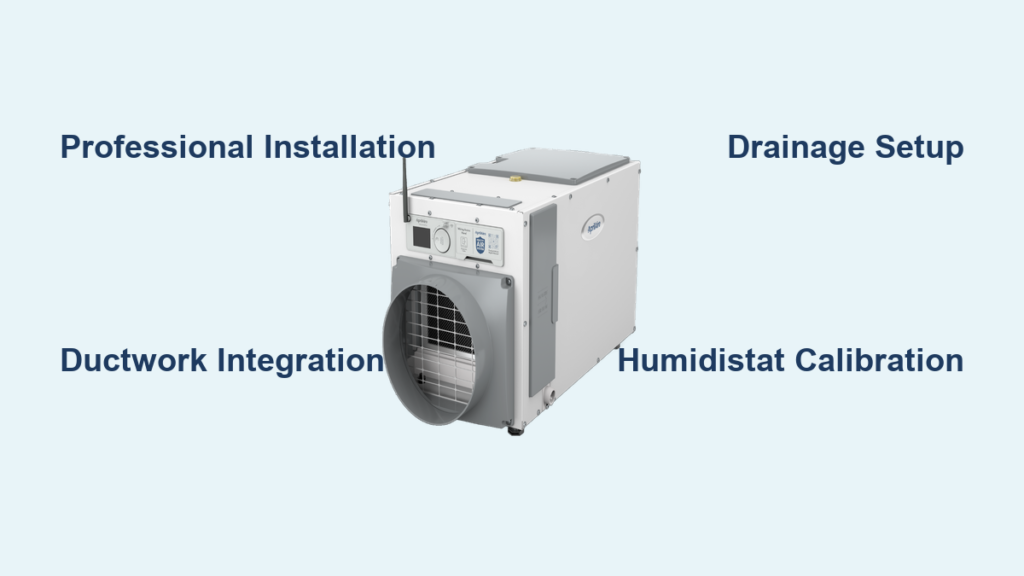
That sticky, clammy feeling in your home even when the AC runs constantly? You’re experiencing what 60% of homeowners face during spring and fall—air conditioners simply can’t manage humidity when temperatures stay moderate. A whole home dehumidifier solves this by integrating with your ductwork to eliminate excess moisture house-wide, banishing musty odors and protecting your home from mold damage. If you’re researching how to install a whole home dehumidifier, understand this upfront: this isn’t a DIY project. Professional installation by a licensed HVAC contractor is mandatory for safety, performance, and warranty protection. Expect 4-6 hours of specialized work costing $1,300-$2,800—knowledge of the process ensures your contractor delivers optimal results.
Skipping professional installation risks catastrophic consequences: voided warranties, electrical hazards, and moisture damage that could cost thousands to repair. This guide details exactly what happens during proper installation so you can verify your contractor’s work meets industry standards. You’ll learn why method selection impacts efficiency, how drainage prevents costly overflows, and what calibration steps guarantee year-round comfort. Let’s dissect the professional installation sequence that transforms uncomfortable humidity into crisp, healthy air.
Why Professional Installation Is Non-Negotiable
Skill Level: 5/5 (Licensed HVAC contractor required)
Duration: 4-6 hours
Investment: $1,300-$2,800 based on home size and complexity
Attempting DIY installation invites disaster. Your contractor must modify ductwork while maintaining static pressure balance, run dedicated electrical circuits to code, and integrate with refrigerant lines in some models. One misstep—like improper duct sealing or incorrect humidistat calibration—causes system strain, moisture reabsorption, or electrical fires. Manufacturers explicitly void warranties for non-professional installations. The $200-$400 “savings” from DIY could easily trigger $5,000 in water damage or HVAC repairs within months.
Optimal Installation Method Selection

Dedicated Return to Supply: The Gold Standard
This method creates a dedicated air pathway that outperforms alternatives by 20-30% in field tests. Your contractor installs a new return grille in a central hallway ceiling (bottom-story for two-story homes), then connects the dehumidifier’s output directly to your supply plenum. Critical advantages:
- Operates independently without triggering your air handler fan
- Prevents dry air from reabsorbing moisture at the AC coil
- Achieves 45-50% humidity levels (vs. 55-60% with legacy methods)
- Uses 15-20% less energy by bypassing unnecessary fan operation
While some homeowners initially notice slightly warmer air from vents (since dry air skips the cooling coil), this rarely causes discomfort and typically triggers AC activation within 15 minutes.
Alternative Methods: When Gold Standard Isn’t Possible
Dedicated Return to Existing Return: Used when supply plenum access is blocked. The dehumidifier pulls air through a new return but discharges into existing return ducts, forcing your air handler fan to circulate dry air. This method still removes humidity but wastes energy running the fan and allows some moisture reabsorption at the coil.
Traditional Return-to-Return: The outdated approach of tying into existing returns. Field data shows 25% higher energy consumption and reduced dehumidification efficiency. Reputable contractors avoid this unless structural constraints leave no alternatives.
Precision Location Selection Process
Structural & Access Requirements
Your contractor evaluates three non-negotiable factors before mounting:
– Proximity to HVAC system (within 15 feet ideal)
– Structural support capacity (70-120 lb unit weight)
– Clearance space (18″ front, 12″ sides/rear for filter access)
In attics, they install steel hanging bars secured to roof trusses with a metal support pan underneath. Basements or utility closets near existing equipment are preferred locations. Visual cue: If the unit wobbles when touched or sits closer than 12″ to walls, demand repositioning—this causes vibration damage and blocks airflow.
Ductwork Integration: The Performance Decider
Return Side Connection Protocol
Step 1: Cut new return grille opening using the unit’s template in a central hallway ceiling location. Pro tip: Contractors use laser levels to ensure perfect alignment with floor joists.
Step 2: Install flexible duct (6-8″ diameter) from dehumidifier to new grille, maintaining smooth curves—sharp bends restrict airflow by 30%.
Step 3: Seal all joints with mastic (not duct tape!), which cracks over time. Critical check: Run a smoke pencil test during commissioning—visible smoke escaping indicates costly air leaks.
Supply Side Connection for Method 1
For dedicated return-to-supply installations, contractors connect the unit’s output to your supply plenum using rigid ductwork. They calculate precise duct sizing to maintain static pressure within manufacturer specs—undersized ducts strain the blower, while oversized ducts waste energy. Warning: If your contractor uses flexible duct here, demand correction—this creates turbulence that reduces efficiency by 25%.
Drainage System: Prevent Costly Water Damage

Condensate Management Essentials
Contractors run ¾” PVC drain lines with a minimum ¼” per foot downward slope to outdoor termination points. Non-negotiable details:
- Terminate 6+ inches from foundation to prevent water seepage
- Install P-trap before outdoor exit to block sewer gases
- Position termination point where you can visually inspect monthly
- Use a condensate pump only when gravity drainage is impossible
Pro insight: Clogged drains cause 70% of service calls. During installation, insist on a cleanout access tee near the unit—this allows quick vacuum clearing without disassembly. If your contractor skips the P-trap or slopes the drain upward, stop work immediately—this invites health hazards and water damage.
Electrical Safety: Zero Room for Error

Dedicated Circuit Requirements
Your contractor coordinates with a licensed electrician to:
– Run a new 15-20 amp, 120-volt circuit from the electrical panel
– Install a disconnect switch within sight of the unit
– Verify GFCI protection meets local codes
– Match voltage exactly to manufacturer specs
Critical warning: Never allow electrical work by HVAC technicians without electrician oversight. Improper grounding causes electrocution risks and voids all warranties. If your contractor suggests “tapping into an existing circuit,” terminate the contract—this creates fire hazards and code violations.
Control System: Your Comfort Command Center
Humidistat Calibration Protocol
Contractors mount the control unit near your thermostat using 18-gauge, 2-conductor wiring. Startup settings:
– Initial humidity setpoint: 35% relative humidity
– Temperature lockout: Disable operation above 90°F or below 40°F
– Ventilation rate: 15 CFM per bedroom plus 15 CFM (per ASHRAE 62.2)
They calibrate accuracy using a digital hygrometer—demand verification that readings match within 2% RH. If your contractor uses the default setting without calibration, humidity levels could swing 10-15% from your target.
Fresh Air Integration: Hidden Health Benefit
Mechanical Ventilation Setup
During installation, contractors add a 4″ outdoor intake duct with MERV 8+ filtration. Critical configuration steps:
1. Calculate fresh air requirements using ASHRAE 62.2 standards
2. Install automatic damper for temperature-based lockouts
3. Program ventilation rates into the control system
4. Add manual override for extreme weather events
This transforms your dehumidifier into an essential ventilation system—particularly crucial in today’s airtight homes where stale indoor air compounds allergy issues.
Performance Verification: The Final Quality Check
6-Point Commissioning Test
Professional contractors always perform these checks before leaving:
1. Confirm electrical connections with multimeter readings
2. Run 30-minute drainage test with colored water
3. Conduct smoke test for duct leaks (visible smoke = failure)
4. Measure airflow from new return grille (should match unit specs)
5. Calibrate humidistat against standalone hygrometer
6. Document final settings in homeowner manual
Red flag: If they skip step 5, humidity levels will drift over time. Demand they show you the calibration reading—it should match within 2% RH.
Maintenance Reality: Avoid Costly Neglect
Filter & Drain Line Protocol
Filters: Change every 2-3 months (monthly with pets). Critical: Use only manufacturer-specified filters—aftermarket versions void warranties and reduce airflow by 40%.
Drain lines: Monthly visual inspection of termination point. Warning signs requiring immediate service:
– Water backing up near unit
– Musty odors from vents
– Humidity levels rising above 55%
Annual professional cleaning with wet-dry vacuum prevents 95% of clogs. If your contractor doesn’t demonstrate the inspection point during installation, you’ll miss early blockage warnings.
Final Note: Proper whole home dehumidifier installation delivers immediate relief from sticky air and long-term protection against mold damage—but only when executed professionally. Before installation day, clear 3-foot access paths to your HVAC system and verify electrical panel space. Post-installation, monitor humidity levels for 48 hours; if levels stay above 55%, demand recalibration. Remember: this isn’t an energy-saving device—it’s a comfort and health investment that pays dividends through improved air quality, structural protection, and daily livability. When contractors follow these critical steps, you’ll transform from “Why is my home always damp?” to “I forgot what humid air felt like.”